

At Randy Brecker’s concert at Bombay’s National Centre for the Performing Arts on July 3 along with drummer Peter Erskine and an all-star band, the trumpet player told the audience that he had been in the city once before – as part of a State Department tour in 1966 when he was a student at Indiana University.
To be honest, I thought he’d got the date wrong. That tour doesn’t find mention in any of the books I’ve read on Washington’s “jazz ambassadors” programme that brought such legends as Dave Brubeck and Duke Ellington to the country.
But after Vivek Menezes found an interview in Jazz Times in which Brecker recalled this trip, I took another look at my material. I realised that Marco Pacci had actually sent me a copy of the flip side of a recording made in 1966 by the Indiana Jazz Ensemble, of which Brecker was a member.
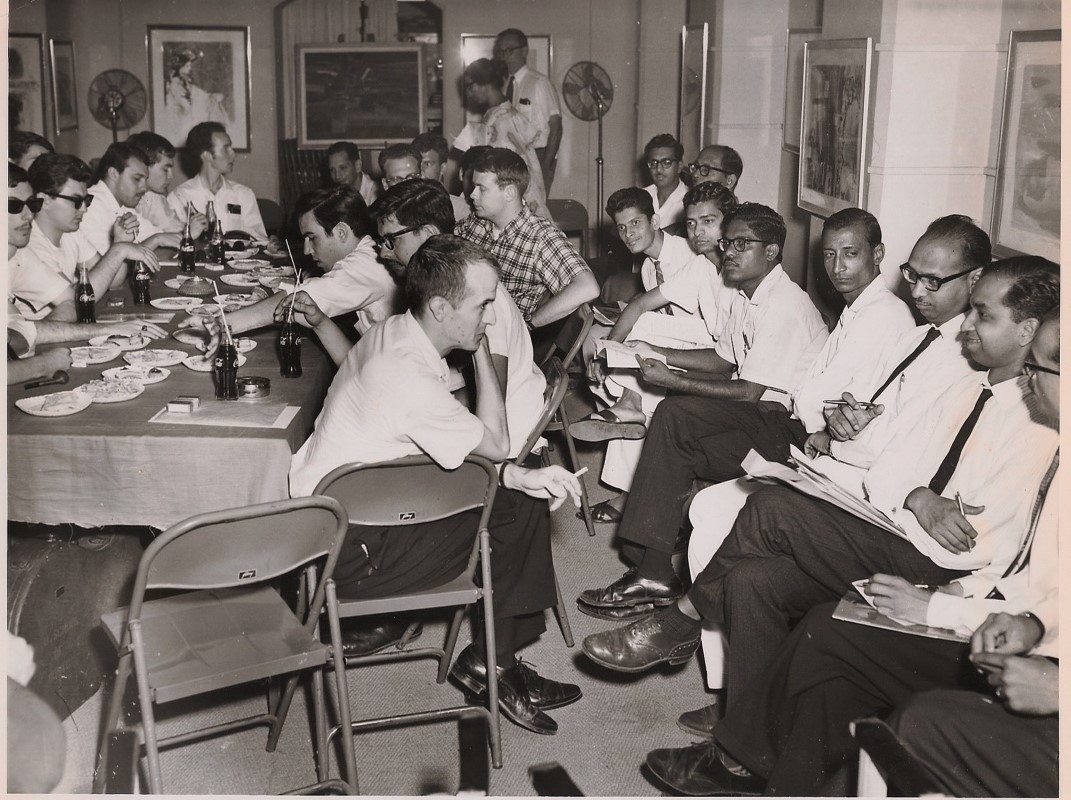
The outfit was directed by Jerry Coker, who is seen in the picture above, talking to the press in Bombay.
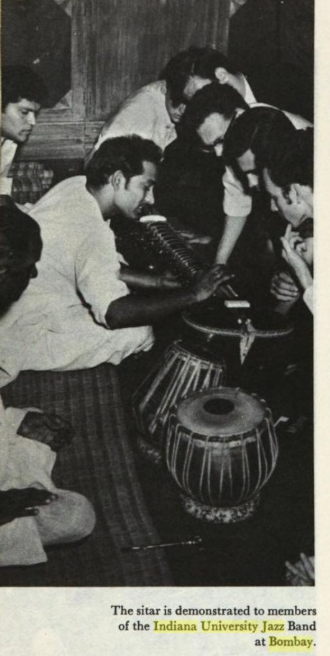
When Narendra Kusnur met Brecker after the concert, the trumpet player told him, “I remember the city as Bombay. It was very different from what it is today. We met many Indian musicians, and discovered the commonality between Indian music and jazz in terms of their improvisation.”
He added that his debut album Score, released in 1968, included a piece called Bangalore, “inspired by the city’s lush greenery”.
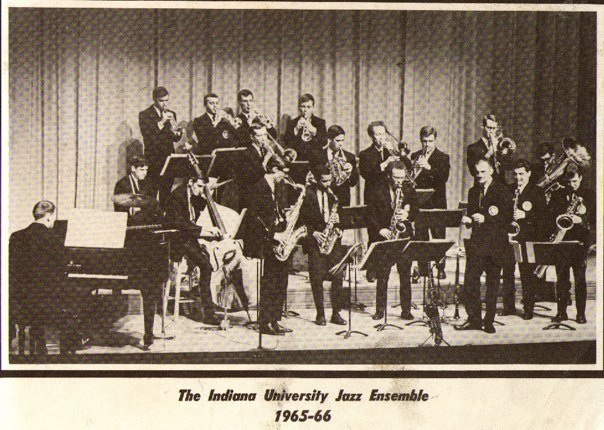
Meanwhile, related to the 1966 Indiana University tour, the institution’s Jacob’s School of Music lists the members of the ensemble as piano, Gary Smart; bass, Brent McKesson; drums, Stan Gage; saxophones, Gary Campbell, Carl Atkins, Jerry Greene, Pat Mancino, Whit Sidener; trombones, horns, tuba Andy McDonald, Paul Navarro, Brian Martz, Mark Williamson, Art Moore, Don Harry; and trumpets Randy Brecker, Larry Wiseman, Chris Gallaher and Craig Andrews.
A US government publication that year offers a more detailed report on the 11-country tour, which started in Sri Lanka and ended in Cyrus. The Indiana out
They played 61 concerts between January 29 and May 17, performing for 69,272 people, the publication says rather precisely. Another 11,000 are estimated to heard them at their informal concerts.
The Indiana University outfit had been chosen to make the trip after being chosen as best American college band at a festival at Notre Dame university in 1965.
India was their second stop. They played concerts in Madras, Bangalore, Bombay and Calcutta. The Akashvani schedule lists them as having done radio broadcasts in Madras and Delhi. The US government publication quotes The Times of India as saying: “Blending the enthusiasm of the amateur with the technical skill of the professionals, the…Ensemble served as an excellent advertisement for the prime musical quality of collegiate musical groups in the US.”
The Indian Express added that the group “played jazz that raises it to a concert art”.
The US publication concludes: “It is to the credit of the group…that an extremely full schedule, covering many thousands of miles by almost every type of transportation, was maintained. It brought popular music to towns with names which are virtually unknown to even well-informed Americans and which had never seen American artists of any type before.”